

Fixed Income Insights
In a nutshell
- Supply-side shocks and higher energy prices have challenged emerging markets, but have not fundamentally reversed the improvement in external resilience and policy frameworks
- The impact of the oil shock is uneven. Net importers face pressure via inflation, current accounts and currencies, while net exporters and commodity-rich economies benefit from stronger terms of trade. However, this distinction is less clear cut in the GCC, where the closure of the Strait of Hormuz and damage to critical hydrocarbon infrastructure have constrained export capacity. Kuwait, Bahrain, Qatar and Iraq are among the most exposed, while Saudi Arabia and the UAE have somewhat greater resilience through alternative export routes and infrastructure
- Transmission channels go beyond crude oil to refined products, fertilisers and helium, influencing food prices, agriculture and technology-linked sectors
- Many emerging market sovereigns now have lower external debt service burdens, deeper local markets and improved inflation credibility, which raise the threshold for broad stress compared with past episodes
- Overall, the environment points towards greater differentiation across emerging markets, with attention to external positions, policy credibility and the presence of commodity or AI-linked export buffers rather than a uniform view on the asset class
Emerging Markets: Resilience tested, not reversed
Supply side shocks and oil price volatility have revived concerns about a fundamental change in the case for emerging markets. Yet, the recent episode created a range of outcomes for countries across EM
Emerging market economies don’t necessarily react to global shocks in an homogenous manner; some have outperformed while others experienced strain.
Higher oil prices can be uncomfortable for emerging markets. They lift import bills, weaken current accounts, exert downward pressure on currencies, raise inflation and complicate central bank policy. For lower income economies, the challenge can be more acute because food and fuel account for a larger share of household spending, while governments often face pressure to cushion consumers through subsidies, tax cuts or price controls.
In previous cycles, that combination might have been enough to trigger a broad risk off environment for the asset class. This time, emerging markets entered from a stronger starting point than in many previous shocks. Inflation credibility has improved in several regions, external debt service burdens are more manageable, local currency funding markets are deeper, and the asset class has become less dependent on foreign currency borrowing.
At the same time, emerging market economies are not as homogeneous as often assumed. Some economies are exposed through oil and food imports. Others are cushioned by commodity exports, improving policy frameworks, AI linked trade or stronger domestic investor bases. The Middle East conflict did not undermine the case for emerging markets, but it reminds us that we need to be selective.
Thus, it becomes important to distinguish between economies that have the buffers to absorb this type of shock, and where external vulnerabilities could become more difficult if the disruption lingers.
Oil was only one transmission channel in a supply shock which was more complex than it looked on the surface.
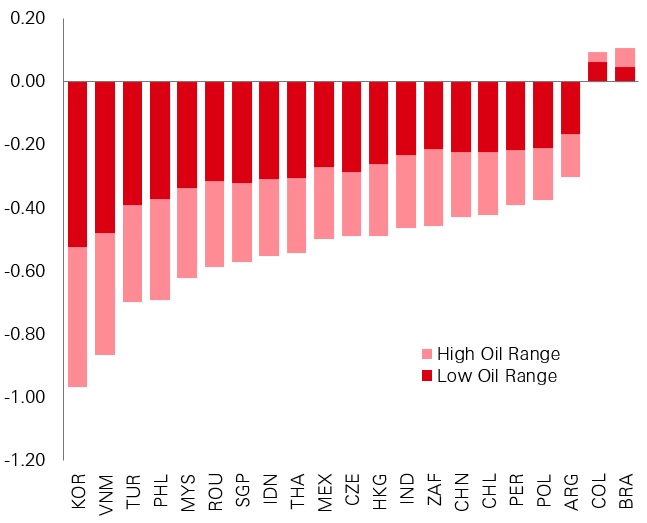
Within emerging markets, Asia was particularly exposed because the region contains several large energy importers, including Korea, Vietnam and the Philippines. Higher energy prices can affect Asian economies through inflation, weaker consumption, lower margins, and pressure on currencies. In contrast, Latin American markets net exporters such as Brazil and Colombia have natural offsets from higher oil prices.
Figure 1: Oil Price Shock GDP impacts: 4 Quarters ahead impact from baseline
Click the image to enlarge
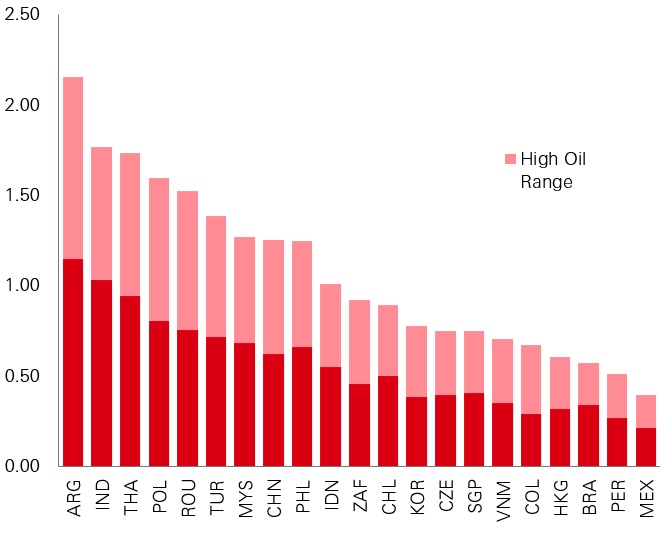
Figure 2: Oil Price Shock Headline CPI impacts: 4 Quarters ahead impact from baseline
Click the image to enlarge
Source: Macrobond, HSBC AM, June 2026.
But crude oil was only one transmission channel. The Strait of Hormuz also matters for refined products, fertilisers, ammonia, helium and other inputs that feed into food, agriculture, semiconductors, healthcare and industrial production. For example, the Strait accounts for roughly 30 per cent of relevant global fertilisers exports, while it is around 25–30 per cent for helium and around 20 per cent for refined oil.
Figure 3: Commodity exports via Strait of Hormuz
| Urea fertiliser |
50% |
Brazil, India, Bangladesh, Philippines, Indonesia |
|
| Ammonia |
30% |
India, Brazil |
|
| LPG / Naphtha |
30% |
Africa, Sri Lanka, Pakistan |
|
| Helium |
29% |
India, Pakistan, Bangladesh, Vietnam, Thailand |
|
| LNG |
19% |
China, India, South Korea |
|
| Refined oil |
19% |
Vietnam |
|
Source: HSBC Asset Management, July 2026.
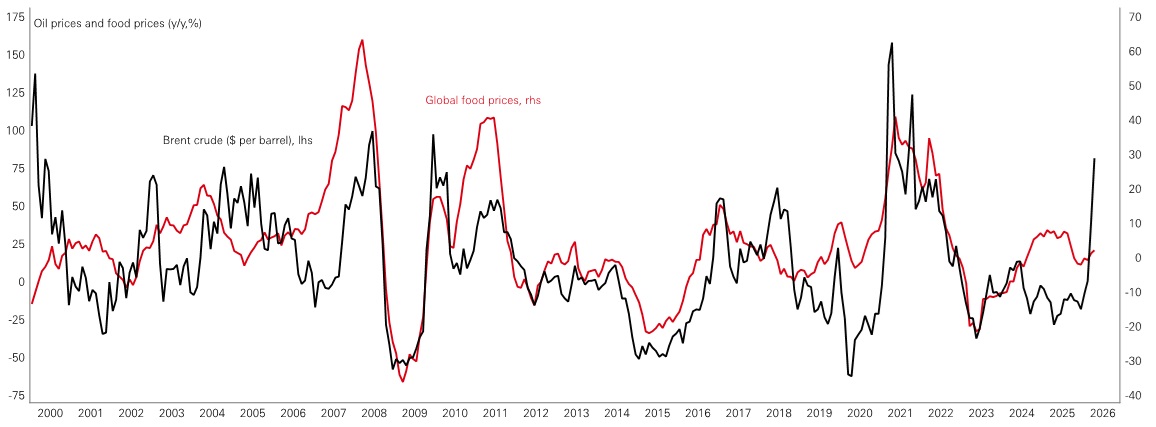
The food channel is especially important. Energy costs feed into fertiliser, transportation and refrigeration. If higher oil prices persist, rising food inflation can follow with a lag. This upside risk to food inflation from oil is compounded by a strong El Niño effect, which will add additional pressures in the second half of 2026 in the Andean region and in Southeast Asia. This is where the shock becomes more political. A rise in petrol prices is painful, but a rise in food prices can quickly affect real incomes, social stability and fiscal policy. For poorer EM economies, this can be the difference between a market shock and a broader macro stress event.
Figure 4: Oil prices and food prices (y/y, per cent)
Click the image to enlarge
Source: Macrobond, HSBC AM, June 2026.
Helium is another example of how an oil shock can move beyond energy. It is used in semiconductors, healthcare and specialist manufacturing. A sustained disruption could therefore affect economies tied to technology supply chains, even where the direct oil exposure is manageable.
There is a timing dimension too. A short disruption can be absorbed through inventories, reserve releases, temporary subsidies and currency flexibility. A longer disruption is more difficult. Inventories fall, fiscal costs rise, inflation expectations become harder to manage, and central banks have less room to support growth. The longer the shock persists, the more it moves from a terms of trade problem to a policy credibility problem.
EM was at a better starting point than in previous episodes.
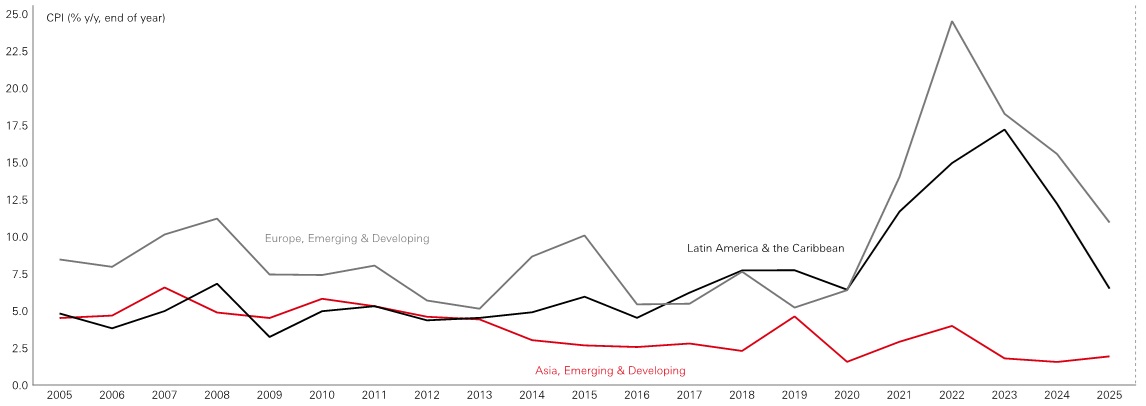
Inflation dynamics have improved across much of the emerging markets complex. In Asia, inflation has been relatively stable, helped by stronger central bank credibility built over time. In Latin America, central banks such as Brazil, Chile and Mexico moved early and aggressively in the last inflation cycle. That helped anchor expectations and contributed to the disinflation seen through 2024 and 2025. Growth has also been more uneven than weak. Asia has benefited from intra-regional trade, the AI technology cycle and stronger export momentum, particularly in economies linked to semiconductors and electronics. Latin America has been more mixed, as high real rates have weighed on domestic demand, but the region also has more commodity exposure. Central and Eastern Europe, by contrast, remains more exposed to weak eurozone demand, particularly through Germany, while still carrying the legacy of the Russia-Ukraine energy shock.
Figure 5: CPI (per cent y/y, end of year)
Click the image to enlarge
Source: Macrobond, HSBC AM, June 2026.
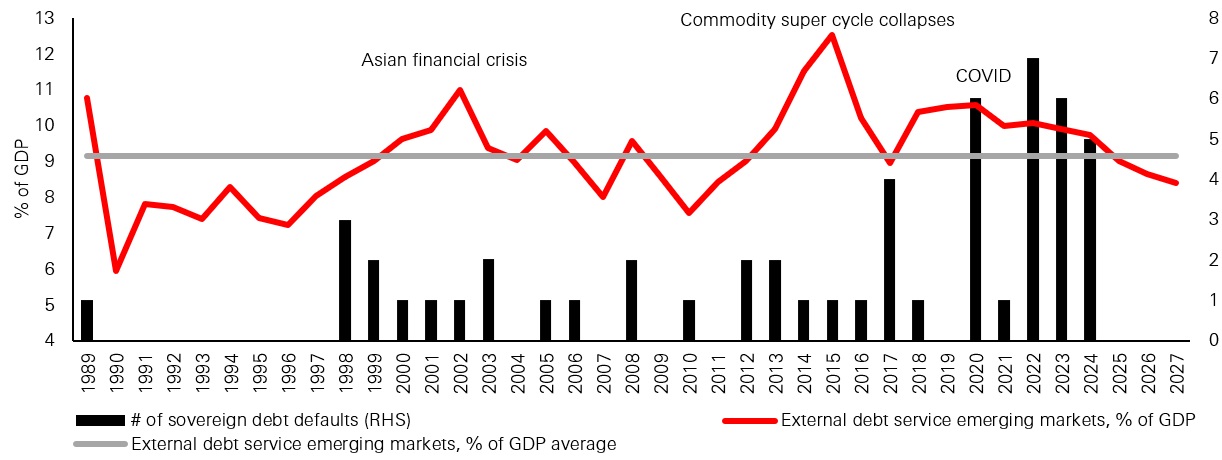
Importantly, there has been a structural improvement is external resilience. EM external debt service is near multi decade lows as a share of GDP. This reflects three changes. First, many EM sovereigns have reduced their reliance on hard currency debt and built deeper local currency funding markets. That reduces the currency mismatch that used to make external shocks more dangerous.
Figure 6: External debt imbalances and resilience
Click the image to enlarge
Source: IMF WEO, HSBC AM, June 2026.
Second, the restructuring cycle after Covid and the Russia-Ukraine shock has left several frontier economies with more manageable debt service profiles. Countries that have gone through IMF programmes or restructurings may still be vulnerable, but they are not necessarily in the same position they were before the previous crisis.
Third, the global backdrop has been supportive enough, helped by higher nominal GDP growth, resilient commodity prices and a weaker US dollar.
None of this means EM is immune. A prolonged or reignited oil shock would still erode current accounts, pressure reserves and tighten financing conditions. But the threshold for broad stress appears higher than in previous cycles. Historically, external debt service burdens closer to 10 per cent of GDP have been associated with more difficult episodes for the asset class. Today, aggregate measures remain well below that level.
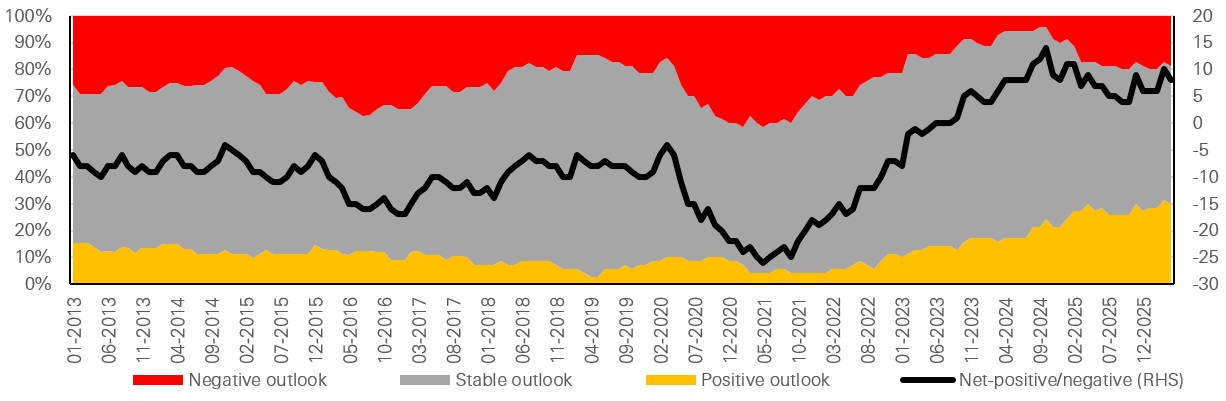
The sovereign ratings backdrop reflects this position. Positive outlooks have increased since the Covid and Russia-Ukraine period, and the overall balance between positive and negative outlooks remains supportive. There have been pressure points among net oil importers, and some Gulf linked credits, but has not yet prompted a systemic deterioration across EM sovereigns. Hence, the conflict has created pressure, but it has not reversed the improvement in EM external fundamentals.
Figure 7: EMBI ratings outlook
Click the image to enlarge
Source: Moody’s, S&P, Fitch, HSBC AM, June 2026.
Asia is where the policy trade off is sharpest, and tension shows up most clearly.
The region is more exposed to imported energy than Latin America, and several economies have a high sensitivity to oil, the US dollar and global volatility. Korea, Vietnam and the Philippines appear particularly exposed in model based estimates of growth sensitivity to higher oil prices. Inflation effects are also concentrated in parts of Asia, especially where energy and food have a high weight in consumer baskets.
Governments responded with a mix of measures. On the demand side, these include energy conservation, tighter import rules and efforts to limit the pass through of global oil prices into domestic fuel prices. On the supply side, countries have used inventories, strategic reserves, higher domestic refined production, alternative energy sources, temporary increases in coal fired power generation and import diversification.
These policies helped smooth the immediate shock for households and businesses. Economic activity held up better than earlier feared in most parts of Asia in H1 2026 despite the energy shock. Most of Asia did not experience meaningful physical disruptions or demand destruction. Yet, these measures are not costless. If domestic fuel prices rise less than global prices, someone absorbs the difference. That may be the government, state owned enterprises, energy companies or future consumers. Over time, the fiscal burden rises.
India’s fuel price adjustment was such a case. After holding prices steady during the early phase of the conflict, the government allowed petrol and diesel prices to rise by around 3 per cent. The move was modest, but it signalled the limits of keeping domestic prices insulated indefinitely.
The Philippines sits at the other end of the spectrum. Its energy market is more deregulated, allowing global price increases to pass through more quickly into domestic inflation. Thailand and Vietnam have also seen signs of broader inflation pressure. Elsewhere, the process has been more gradual, but the direction is clear. If the shock recurs, governments will eventually have to choose between maintaining price support, reallocating spending from other priorities, or passing more costs through to households and businesses.
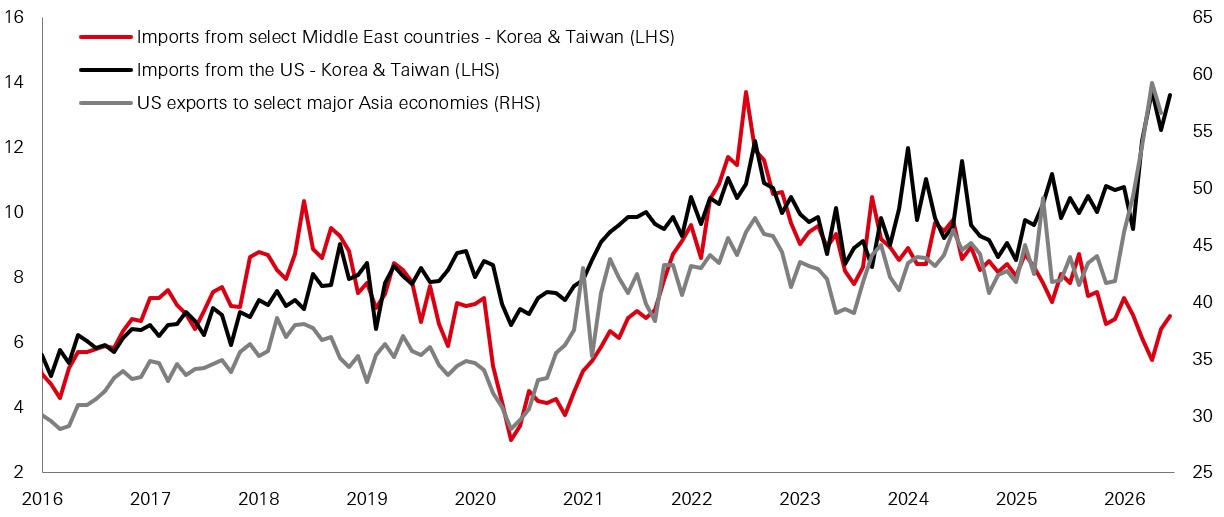
Figure 8: Diversifying energy import sources (USD bn)
Click the image to enlarge
Source: CEIC, Bloomberg, HSBC AM, June 2026.
Supply substitution also has limits. Higher US oil and gas exports can help offset reduced Middle Eastern supply in the short term, but many Asian refineries are designed to process heavier sour Middle Eastern crude. Switching to lighter US crude can reduce efficiency and does not fully solve the problem.
Inventory differences matter too. North Asian economies such as China, Korea and Japan generally have larger reserves. South and Southeast Asian economies have thinner buffers. The Philippines, for example, could face shortages in oil products or jet fuel if disruption persisted and alternative sources were not available quickly enough.
Stagflation risks and balance of payments pressures complicate monetary policy trade-offs between price/ macro-financial stability and growth support. The likely outcome is a cautious policy stance by Asian central banks, which stay vigilant about second-round effects on core inflation and inflation expectations and FX volatility. Relative AI exposure and energy vulnerability is shaping economic divergence and driving a varied pace and scale of policy support across the region. We expect idiosyncratic stories to dominate in H2 with varied fiscal policy headroom and continued divergence in policy reaction functions across Asia.
The oil shock is not the only force at work. Two structural investment cycles provide important offsets.
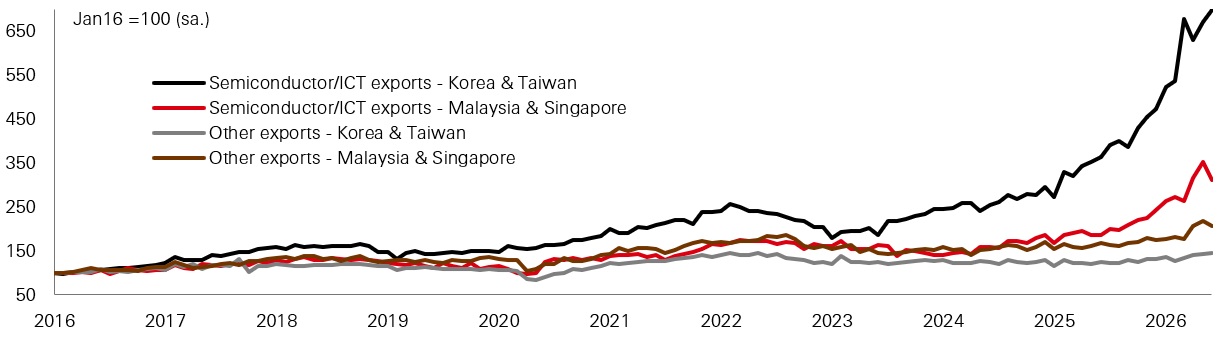
The AI cycle is providing an important offset, especially in Asia. Strong AI demand has boosted exports in technology heavy economies such as Korea, Taiwan and China. Parts of ASEAN, including Singapore, Malaysia and to some extent Thailand, have also benefited from the electronics and technology cycle. These economies could again face energy price pressures, but AI linked export strength provides a growth buffer that was not present in the same way in previous shocks.
There are vulnerabilities too. Semiconductor production depends on stable power supply and specialised inputs, including rare gases such as helium. A prolonged disruption could create bottlenecks. However, large technology companies have improved inventory management, diversified sourcing and increased recycling. Governments are also likely to prioritise strategic industries such as semiconductors and data centres when allocating power or managing supply constraints.
Figure 9: Export value (USD)
Click the image to enlarge
Source: CEIC, Bloomberg, HSBC AM, June 2026.
Energy security is the second offset. In the short term, some Asian countries may rely more heavily on coal fired power to reduce pressure from expensive oil and gas. That may create a temporary setback from a sustainability perspective. Over time, however, the direction is likely to be more investment in renewables, nuclear, grids, storage and electrification. Many regional economies have also pursued transnational power grid interconnections for example the ASEAN Power Grid (APG) initiative.
The shock therefore sits within a wider capex story. Stable and affordable electricity is now a competitive advantage, not just a utility sector issue. It matters for data centres, semiconductor fabrication, industrial automation and advanced manufacturing. China and India are already moving quickly in this area. China remains well positioned because of its scale, cost advantage and leadership across renewables, EVs and power equipment. India has also scaled clean energy rapidly, with around half of installed electric power capacity now coming from non fossil fuel sources. Across Asia, energy security, resilience and affordability are likely to drive public spending and private investment higher over the coming years.
Given the varied impact of the shock, the investment implications are about identifying the right kind of EM exposure.
The most obvious beneficiaries are net commodity exporters. Oil exporters in Latin America, parts of Central Asia and selected frontier markets can benefit from higher prices, especially where policy frameworks are credible and external balances are strong. Brazil and Colombia have natural offsets from higher oil prices, while economies such as Kazakhstan and Azerbaijan may become more important as Europe looks to diversify energy supply. Some frontier exporters in sub Saharan Africa could also benefit, although local debt and governance dynamics remain important. These are some countries which import energy but have meaningful offsets from metals, AI linked exports or policy flexibility. Chile and Peru benefit from copper and other metals. South Africa and Zambia have exposure to industrial metals. Korea and Taiwan face energy import pressure, but they also sit at the centre of the semiconductor industry. Malaysia and Singapore have technology exposure and stronger policy buffers. Mexico exports crude oil, but it is also a net importer of refined gasoline products. Higher oil prices can support petroleum related revenues, but they can also hurt consumers and reduce fuel tax receipts. Add in investment climate uncertainty and US demand sensitivity, and Mexico becomes more ambiguous than a simple oil exporter label suggests.
Resilient metals prices provide an additional cushion for some net oil importers. Strong export receipts from copper in Chile and Peru, and from precious and industrial metals in South Africa, can partly offset the higher energy import bill. This has helped contain pressure on their currencies and moderated the need for central banks to respond with more aggressive rate increases.
The more vulnerable group includes economies with large manufacturing bases tied to weaker developed market demand, net oil import dependence and limited room for policy support. Central Europe and Turkey are exposed to weaker European growth and energy costs. Central America and the Caribbean face oil import pressures and are more dependent on US demand. South Asia, including India, Pakistan and Sri Lanka, and parts of ASEAN with less fiscal and monetary policy space, are more exposed if the shock lasts. Even within this group, the picture is not uniformly negative. Pakistan and Sri Lanka, for example, are under IMF programmes, which means they have access to financing and are allowing more currency flexibility. Sri Lanka’s restructuring has reduced near term debt service burdens. Pakistan’s current account has improved and financing needs are lower than during the Ukraine shock. These countries may still face pressure, but they are better equipped than before.
EM assets are still sensitive to developed market rates and the US dollar.
Before the conflict, investors expected rate cuts from the Fed and other developed market central banks. Higher oil prices have complicated that view. If inflation remains elevated and markets begin to price a more hawkish path, US rates could become a headwind for EM capital flows. This matters because EM assets are still sensitive to the dollar and global liquidity. Higher US real yields and a stronger dollar would tighten financial conditions, especially for economies with weaker external balances. The effect may be less severe than in previous cycles because external debt service burdens are lower and local currency markets are deeper, but it would still matter.
In the medium term, if Asia and the GCC need to spend more domestically on AI infrastructure, energy security and supply chain resilience, their current account surpluses may decline. These regions have historically recycled excess savings into dollar assets. Less recycling could support a weaker dollar regime over time, which might be helpful for EM.
For informational purposes only and should not be construed as a recommendation to invest in the specific country, product, strategy, sector, or security. The views expressed above were held at the time of preparation and are subject to change without notice. Any forecast, projection or target where provided is indicative only and not guaranteed in any way. HSBC Asset Management accepts no liability for any failure to meet such forecast, projection or target. Source: HSBC Asset Management, July 2026.
Continue reading: Global credit: From energy price shocks to supply risk
Important information
For Professional Clients and intermediaries within countries and territories set out below; and for Institutional Investors and Financial Advisors in the US. This document should not be distributed to or relied upon by Retail clients/investors.
The value of investments and the income from them can go down as well as up and investors may not get back the amount originally invested. The performance figures contained in this document relate to past performance, which should not be seen as an indication of future returns. Future returns will depend, inter alia, on market conditions, investment manager’s skill, risk level and fees. Where overseas investments are held the rate of currency exchange may cause the value of such investments to go down as well as up. Investments in emerging markets are by their nature higher risk and potentially more volatile than those inherent in some established markets. Economies in emerging markets generally are heavily dependent upon international trade and, accordingly, have been and may continue to be affected adversely by trade barriers, exchange controls, managed adjustments in relative currency values and other protectionist measures imposed or negotiated by the countries and territories with which they trade. These economies also have been and may continue to be affected adversely by economic conditions in the countries and territories in which they trade.
The contents of this document may not be reproduced or further distributed to any person or entity, whether in whole or in part, for any purpose. All non-authorised reproduction or use of this document will be the responsibility of the user and may lead to legal proceedings. The material contained in this document is for general information purposes only and does not constitute advice or a recommendation to buy or sell investments. Some of the statements contained in this document may be considered forward looking statements which provide current expectations or forecasts of future events. Such forward looking statements are not guarantees of future performance or events and involve risks and uncertainties. Actual results may differ materially from those described in such forward-looking statements as a result of various factors. We do not undertake any obligation to update the forward-looking statements contained herein, or to update the reasons why actual results could differ from those projected in the forward-looking statements. This document has no contractual value and is not by any means intended as a solicitation, nor a recommendation for the purchase or sale of any financial instrument in any jurisdiction in which such an offer is not lawful. The views and opinions expressed herein are those of HSBC Asset Management at the time of preparation and are subject to change at any time. These views may not necessarily indicate current portfolios' composition. Individual portfolios managed by HSBC Asset Management primarily reflect individual clients' objectives, risk preferences, time horizon, and market liquidity. Foreign and emerging markets: investments in foreign markets involve risks such as currency rate fluctuations, potential differences in accounting and taxation policies, as well as possible political, economic, and market risks. These risks are heightened for investments in emerging markets which are also subject to greater illiquidity and volatility than developed foreign markets. This commentary is for information purposes only. It is a marketing communication and does not constitute investment advice or a recommendation to any reader of this content to buy or sell investments nor should it be regarded as investment research. It has not been prepared in accordance with legal requirements designed to promote the independence of investment research and is not subject to any prohibition on dealing ahead of its dissemination. This document is not contractually binding nor are we required to provide this to you by any legislative provision.
All data from HSBC Asset Management unless otherwise specified. Any third-party information has been obtained from sources we believe to be reliable, but which we have not independently verified.
HSBC Asset Management is the brand name for the asset management business of HSBC Group, which includes the investment activities that may be provided through our local regulated entities. HSBC Asset Management is a group of companies in many countries and territories throughout the world that are engaged in investment advisory and fund management activities, which are ultimately owned by HSBC Holdings Plc. (HSBC Group).
- In Australia, this document is issued by HSBC Bank Australia Limited ABN 48 006 434 162, AFSL 232595, for HSBC Global Asset Management (Hong Kong) Limited ARBN 132 834 149 and HSBC Global Asset Management (UK) Limited ARBN 633 929 718. This document is for institutional investors only and is not available for distribution to retail clients (as defined under the Corporations Act). HSBC Global Asset Management (Hong Kong) Limited and HSBC Global Asset Management (UK) Limited are exempt from the requirement to hold an Australian financial services license under the Corporations Act in respect of the financial services they provide. HSBC Global Asset Management (Hong Kong) Limited is regulated by the Securities and Futures Commission of Hong Kong under the Hong Kong laws, which differ from Australian laws. HSBC Global Asset Management (UK) Limited is regulated by the Financial Conduct Authority of the United Kingdom and, for the avoidance of doubt, includes the Financial Services Authority of the United Kingdom as it was previously known before 1 April 2013, under the laws of the United Kingdom, which differ from Australian laws;
- In Bermuda, this document is issued by HSBC Global Asset Management (Bermuda) Limited, of 37 Front Street, Hamilton, Bermuda which is licensed to conduct investment business by the Bermuda Monetary Authority;
- In France, Belgium, Netherlands, Luxembourg, Portugal, Greece, Finland, Norway, Denmark, Spain and Sweden this document is issued by HSBC Global Asset Management (France), a Portfolio Management Company authorised by the French regulatory authority AMF (no. GP99026);
- In Germany, this document is issued by HSBC Global Asset Management (Deutschland) GmbH which is regulated by BaFin (German clients) respective by the Austrian Financial Market Supervision FMA (Austrian clients);
- In Hong Kong, this document is issued by HSBC Global Asset Management (Hong Kong) Limited, which is regulated by the Securities and Futures Commission. This content has not been reviewed by the Securities and Futures Commission;
- In India, this document is issued by HSBC Asset Management (India) Pvt Ltd. which is regulated by the Securities and Exchange Board of India;
- In Italy, this document is issued by HSBC Global Asset Management (France), a Portfolio Management Company authorised by the French regulatory authority AMF (no. GP99026), through its Italian branch, regulated by Banca d’Italia and Commissione Nazionale per le Società e la Borsa (Consob);
- In Japan, this document is issued by HSBC Asset Management (Japan) Ltd (JRN 3010001124868), regulated by the Financial Services Agency;
- In Malta, this document is issued by HSBC Global Asset Management (Malta) Limited which is regulated and licensed to conduct Investment Services by the Malta Financial Services Authority under the Investment Services Act;
- In Mexico, this document is issued by HSBC Global Asset Management (Mexico), SA de CV, Sociedad Operadora de Fondos de Inversión, Grupo Financiero HSBC which is regulated by Comisión Nacional Bancaria y de Valores;
- In the United Arab Emirates, this document is issued by HSBC Investment Funds (Luxembourg) S.A. – Dubai Branch (Level 20, HSBC Tower, PO Box 66, Downtown Dubai, United Arab Emirates) regulated by the Capital Market Authority (CMA) in the UAE to conduct investment fund management, portfolios management, fund administration activities (CMA Category 2 license No.20200000336) and promotion activities (CMA Category 5 license No.20200000327).
- In the United Arab Emirates, this document is issued by HSBC Global Asset Management MENA, a unit within HSBC Bank Middle East Limited, U.A.E Branch, PO Box 66 Dubai, UAE, regulated by the Central Bank of the U.A.E. and the Capital Market Authority in the UAE under CMA license number 602004 for the purpose of this promotion and lead regulated by the Dubai Financial Services Authority. HSBC Bank Middle East Limited is a member of the HSBC Group and HSBC Global Asset Management MENA are marketing the relevant product only in a sub-distributing capacity on a principal-to-principal basis. HSBC Global Asset Management MENA may not be licensed under the laws of the recipient’s country of residence and therefore may not be subject to supervision of the local regulator in the recipient’s country of residence. One of more of the products and services of the manufacturer may not have been approved by or registered with the local regulator and the assets may be booked outside of the recipient’s country of residence.
- In Singapore, this document is issued by HSBC Global Asset Management (Singapore) Limited, which is regulated by the Monetary Authority of Singapore. The content in the document/video has not been reviewed by the Monetary Authority of Singapore;
- In Switzerland, this document is issued by HSBC Global Asset Management (Switzerland) AG. This document is intended for professional investor use only. For opting in and opting out according to FinSA, please refer to our website; if you wish to change your client categorization, please inform us. HSBC Global Asset Management (Switzerland) AG having its registered office at Gartenstrasse 26, PO Box, CH-8002 Zurich has a licence as an asset manager of collective investment schemes and as a representative of foreign collective investment schemes. Disputes regarding legal claims between the Client and HSBC Global Asset Management (Switzerland) AG can be settled by an ombudsman in mediation proceedings. HSBC Global Asset Management (Switzerland) AG is affiliated to the ombudsman FINOS having its registered address at Talstrasse 20, 8001 Zurich. There are general risks associated with financial instruments, please refer to the Swiss Banking Association (“SBA”) Brochure “Risks Involved in Trading in Financial Instruments”;
- In Taiwan, this document is issued by HSBC Global Asset Management (Taiwan) Limited which is regulated by the Financial Supervisory Commission R.O.C. (Taiwan);
- In Turkiye, this document is issued by HSBC Asset Management A.S. Turkiye (AMTU) which is regulated by Capital Markets Board of Turkiye. Any information here is not intended to distribute in any jurisdiction where AMTU does not have a right to. Any views here should not be perceived as investment advice, product/service offer and/or promise of income. Information given here might not be suitable for all investors and investors should be giving their own independent decisions. The investment information, comments and advice given herein are not part of investment advice activity. Investment advice services are provided by authorized institutions to persons and entities privately by considering their risk and return preferences, whereas the comments and advice included herein are of a general nature. Therefore, they may not fit your financial situation and risk and return preferences. For this reason, making an investment decision only by relying on the information given herein may not give rise to results that fit your expectations.
- In the UK, this document is issued by HSBC Global Asset Management (UK) Limited, which is authorised and regulated by the Financial Conduct Authority;
- In the US, this document is issued by HSBC Securities (USA) Inc., an HSBC broker dealer registered in the US with the Securities and Exchange Commission under the Securities Exchange Act of 1934. HSBC Securities (USA) Inc. is also a member of NYSE/FINRA/SIPC. HSBC Securities (USA) Inc. is not authorized by or registered with any other non-US regulatory authority. The contents of this document are confidential and may not be reproduced or further distributed to any person or entity, whether in whole or in part, for any purpose without prior written permission.
- In Chile, operations by HSBC's headquarters or other offices of this bank located abroad are not subject to Chilean inspections or regulations and are not covered by warranty of the Chilean state. Obtain information about the state guarantee to deposits at your bank or on www.cmfchile.cl;
- In Colombia, HSBC Bank USA NA has an authorized representative by the Superintendencia Financiera de Colombia (SFC) whereby its activities conform to the General Legal Financial System. SFC has not reviewed the information provided to the investor. This document is for the exclusive use of institutional investors in Colombia and is not for public distribution;
- In Costa Rica, the Fund and any other products or services referenced in this document are not registered with the Superintendencia General de Valores (“SUGEVAL”) and no regulator or government authority has reviewed this document, or the merits of the products and services referenced herein. This document is directed at and intended for institutional investors only.
- In Peru, HSBC Bank USA NA has an authorized representative by the Superintendencia de Banca y Seguros in Perú whereby its activities conform to the General Legal Financial System - Law No. 26702. Funds have not been registered before the Superintendencia del Mercado de Valores (SMV) and are being placed by means of a private offer. SMV has not reviewed the information provided to the investor. This document is for the exclusive use of institutional investors in Perú and is not for public distribution;
- In Uruguay, operations by HSBC's headquarters or other offices of this bank located abroad are not subject to Uruguayan inspections or regulations and are not covered by warranty of the Uruguayan state. Further information may be obtained about the state guarantee to deposits at your bank or on www.bcu.gub.uy.
Copyright © HSBC Global Asset Management Limited 2026. All rights reserved. No part of this publication may be reproduced, stored in a retrieval system, or transmitted, on any form or by any means, electronic, mechanical, photocopying, recording, or otherwise, without the prior written permission of HSBC Asset Management.
Content ID: D076048; Expiry Date: 30.06.2027


