
Expanding the Faithful Frontier
Summary
- Shariah-compliant multi-asset solutions are essential for faith-based investors seeking improved retirement outcomes and financial security
- Low-cost, diversified asset-class-level exposures, often through passive strategies, are crucial for achieving broad diversification and long-term sustainability
- Effective Shariah-compliant investments require oversight from a Shariah supervisory board and dividend purification
- Equities drive growth, Sukuk provide defensive stability, supported by gold and property for added diversification and flexibility
Providing meaningful investment and retirement solutions for Shariah-compliant investors is crucial in helping faith-based investors achieve improved retirement outcomes, long-term financial security, and reduced reliance on the state. Yet, despite growth in demand, Shariah-compliant investment options remain limited. As a result, some Muslim investors may have been forced to choose between hybrid portfolios that mix Shariah-compliant and conventional holdings, overly risky concentrated strategies, or—in many cases—choosing not to invest at all.
This landscape is now changing rapidly. Major providers such as HSBC Asset Management are bringing new Shariah-compliant products to market at pace, helping to close the gap and enabling faith-based investors to access retirement solutions that mirror the outcomes available from more established products. Interestingly, there is considerable overlap between faith-based investment screening and responsible or ethical investment approaches, given the focus on excluding harmful industries and prioritising cleaner balance sheets.
A defining feature of a good Shariah-compliant investment solution is rigorous oversight from a recognised Shariah supervisory board, something providers must treat as central rather than optional. Dividend purification is equally essential; without applying purification across all funds, an investment cannot be considered fully Shariah-compliant.
As with any robust multi-asset solution, the foundation lies in the quality and cost-efficiency of the building blocks used. Low-cost, asset-class-level exposures—possibly delivered through passive strategies—play a vital role in helping Shariah-compliant portfolios achieve broad diversification, appropriate risk management, and long-term sustainability.
Equities: The growth engine
Equities are typically the cornerstone of the growth component in any multi-asset portfolio, and this remains true in a Shariah-compliant context. A global equity allocation usually forms the backbone of the equity sleeve, providing diversified exposure across regions, sectors, and economic cycles. For investors seeking long-term capital appreciation, Shariah-compliant equities therefore represent one of the most important building blocks.
Shariah screening for equities involves a dual process designed to ensure alignment with Islamic ethical and financial principles. The first part is business activity screening, which excludes companies generating significant revenue from non-permissible activities such as alcohol, tobacco, gambling, pork products, adult entertainment, and conventional financial services, among others. This is closely aligned with many ethical or ESG-driven exclusions, highlighting the natural overlap between Shariah investment principles and broader responsible-investment practices.
The second part of the screening is financial ratio screening, where companies with excessive leverage or interest-based income are removed. Standards such as those issued by the Accounting and Auditing Organization for Islamic Financial Institutions (AAOIFI) set quantitative thresholds, typically limiting total debt, cash, and interest-bearing instruments to specific proportions of a company’s market capitalisation. This ensures that investors are not exposed to businesses that rely heavily on interest-based financing, which is prohibited under Islamic law.
Although the screening process is robust, many companies still derive small, incidental amounts of income from non-permissible sources. This makes dividend purification essential. Purification involves identifying the portion of dividend income attributable to non-halal activities and donating that portion to charity. Without this step, portfolios may comply with screening criteria but fall short of being fully Shariah-compliant.
Shariah-compliant equity indices and passive strategies built upon them therefore offer a cost-effective, diversified, and principled means of accessing global equity markets while aligning with Islamic values. Their role in driving long-term growth makes them essential for multi-asset Shariah portfolios.
Sukuk: the defensive anchor
While equities provide growth, multi-asset portfolios also require defensive assets to help manage volatility and deliver stability through market cycles. In Shariah-compliant portfolios, this defensive allocation is achieved primarily through Sukuk, the Islamic alternative to conventional fixed income. Passive Sukuk exposures at the broad asset-class level are often the most efficient way to access this market, offering diversification, transparency, and lower costs.
Sukuk share similarities with conventional bonds in terms of providing periodic cash flows and returning principal at maturity, but they differ fundamentally in structure. Sukuk must represent partial ownership of an underlying tangible asset or a pool of assets, avoiding interest-bearing debt relationships. Their contractual frameworks are therefore asset-backed or asset-based, ensuring compliance with Islamic principles that prohibit riba (interest). Despite these structural differences, Sukuk still provide exposure to the global duration factor, meaning they respond to interest-rate movements in a way that is broadly comparable to traditional fixed income.
Another important characteristic of Sukuk markets is their issuer base. Sukuk are predominantly issued by sovereigns, quasi-sovereigns, and corporates from the Middle East and parts of Asia. As a result, Sukuk benchmarks often exhibit characteristics reminiscent of emerging-market income, including higher yields, exposure to faster-growing economies, and sometimes elevated geopolitical or credit considerations.
This means building the defensive sleeve of a Shariah-compliant multi-asset portfolio requires careful thought. While Sukuk provide diversification and stability, investors must be aware of the regional concentration and the risk profile embedded within the asset class. Nonetheless, when used in combination with global Shariah-compliant equities and other permissible assets, Sukuk play a crucial role in delivering balanced, risk-managed retirement solutions.
Bringing it all together
As the Islamic investment ecosystem matures, a logical next step has been the development of fully diversified multi-asset portfolios that bridge the risk spectrum between equities and bonds. This evolution is especially relevant for defined contribution (DC) schemes, offering a smoother investment journey without compromising on Shariah principles. This ensures investors can stay on track throughout their retirement lifecycle – while also providing additional self-selection options that align more closely with individual risk preferences.
Typical Shariah Multi-Asset Balanced Portfolio
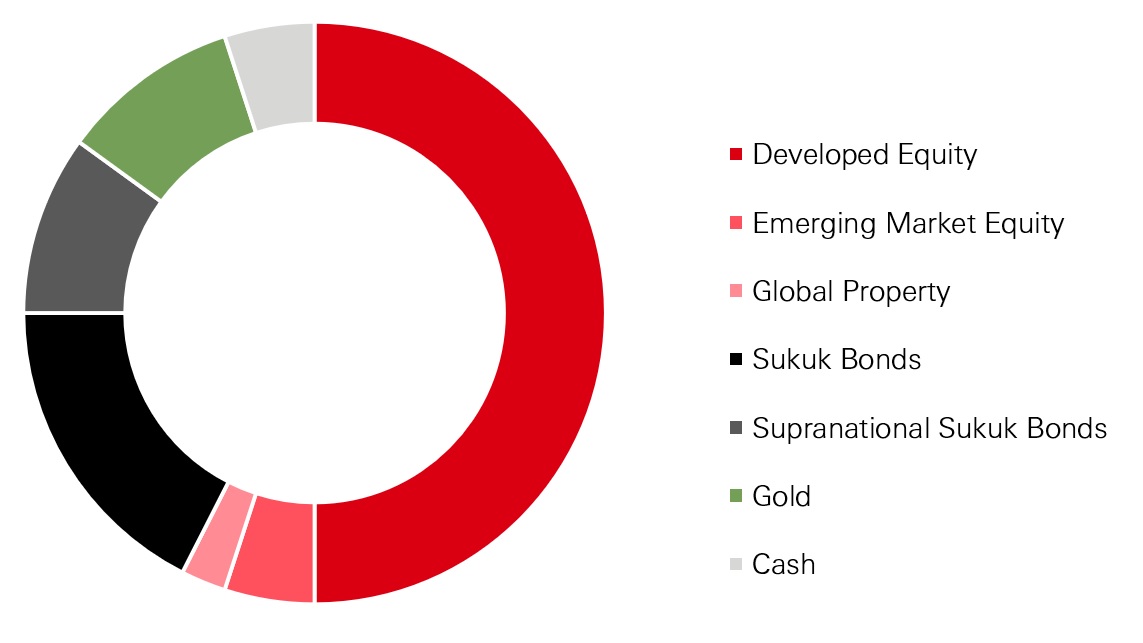
The construction of Shariah-compliant multi-asset portfolio begins with careful evaluation of the available universe. Key building blocks include Islamic equities, screened property exposures, Sukuk bonds and physical gold. Each plays a distinct role in achieving diversification and risk control. While many portfolios rely heavily on developed market sovereign bonds for stability, Shariah portfolios must look to alternatives like Sukuk and gold to fulfil similar functions – despite their differing risk-return characteristics.
From a multi-asset standpoint, government bonds play four important roles in portfolio construction: they provide liquidity, safe haven properties, diversification, and lower volatility than their equity counterparts. However, the emerging market nature of Sukuk, albeit investment grade, means its volatility profile is almost twice as volatile as global government bonds, implying the de-risking impact is less effective. Correlation is also higher between Sukuk and equity markets, while liquidity is more constrained within Sukuk bonds.
Therefore, we need to look broader to fully embed defensiveness into the portfolio. As such, gold becomes a valuable diversifier. While gold has a relatively high volatility profile, it exhibits low correlation to equities and therefore contributes to volatility smoothing when combined with both equity and fixed income assets.
Additionally, investors can also expand their toolkit within the fixed income market. Instruments such as International Islamic Liquidity Management (IILM) certificates, which are sub-12-month maturity, sit outside of the traditional Sukuk benchmark. Including them in the portfolio offers shorter duration exposure, improving portfolio flexibility through the ability to respond more nimbly to market shifts while also offering attractive carry properties.
The expansion of Shariah-compliant investment tools marks another step forward in accessing diversified, risk-managed portfolios without compromising faith. As the market continues to deepen and new asset classes are formed, Islamic multi-asset portfolios will become even more sophisticated, while remaining firmly rooted in Shariah values.
Source: HSBC Asset Management, December 2025.
This information shouldn't be considered as a recommendation to buy or sell specific investments mentioned. Shariah investment restrictions may result in the funds performing less well than funds with similar objectives which are not subject to these restrictions. The views expressed above were held at the time of preparation and are subject to change without notice. The views expressed above were held at the time of preparation and are subject to change without notice. The value of investments and any income from them can go down as well as up and investors may not get back the amount originally invested.
Important Information
For Professional Clients and intermediaries within countries and territories set out below; and for Institutional Investors and Financial Advisors in the US. This document should not be distributed to or relied upon by Retail clients/investors.
The value of investments and the income from them can go down as well as up and investors may not get back the amount originally invested. The performance figures contained in this document relate to past performance, which should not be seen as an indication of future returns. Future returns will depend, inter alia, on market conditions, investment manager’s skill, risk level and fees. Where overseas investments are held the rate of currency exchange may cause the value of such investments to go down as well as up. Investments in emerging markets are by their nature higher risk and potentially more volatile than those inherent in some established markets. Economies in Emerging Markets generally are heavily dependent upon international trade and, accordingly, have been and may continue to be affected adversely by trade barriers, exchange controls, managed adjustments in relative currency values and other protectionist measures imposed or negotiated by the countries and territories with which they trade. These economies also have been and may continue to be affected adversely by economic conditions in the countries and territories in which they trade.
The contents of this document may not be reproduced or further distributed to any person or entity, whether in whole or in part, for any purpose. All non-authorised reproduction or use of this document will be the responsibility of the user and may lead to legal proceedings. The material contained in this document is for general information purposes only and does not constitute advice or a recommendation to buy or sell investments. Some of the statements contained in this document may be considered forward looking statements which provide current expectations or forecasts of future events. Such forward looking statements are not guarantees of future performance or events and involve risks and uncertainties. Actual results may differ materially from those described in such forward-looking statements as a result of various factors. We do not undertake any obligation to update the forward-looking statements contained herein, or to update the reasons why actual results could differ from those projected in the forward-looking statements. This document has no contractual value and is not by any means intended as a solicitation, nor a recommendation for the purchase or sale of any financial instrument in any jurisdiction in which such an offer is not lawful. The views and opinions expressed herein are those of HSBC Asset Management at the time of preparation, and are subject to change at any time. These views may not necessarily indicate current portfolios' composition. Individual portfolios managed by HSBC Asset Management primarily reflect individual clients' objectives, risk preferences, time horizon, and market liquidity. Foreign and emerging markets. Investments in foreign markets involve risks such as currency rate fluctuations, potential differences in accounting and taxation policies, as well as possible political, economic, and market risks. These risks are heightened for investments in emerging markets which are also subject to greater illiquidity and volatility than developed foreign markets. This commentary is for information purposes only. It is a marketing communication and does not constitute investment advice or a recommendation to any reader of this content to buy or sell investments nor should it be regarded as investment research. It has not been prepared in accordance with legal requirements designed to promote the independence of investment research and is not subject to any prohibition on dealing ahead of its dissemination. This document is not contractually binding nor are we required to provide this to you by any legislative provision.
All data from HSBC Asset Management unless otherwise specified. Any third party information has been obtained from sources we believe to be reliable, but which we have not independently verified.
HSBC Asset Management is the brand name for the asset management business of HSBC Group, which includes the investment activities that may be provided through our local regulated entities. HSBC Asset Management is a group of companies in many countries and territories throughout the world that are engaged in investment advisory and fund management activities, which are ultimately owned by HSBC Holdings Plc. (HSBC Group). The above communication is distributed by the following entities:
- In Australia, this document is issued by HSBC Bank Australia Limited ABN 48 006 434 162, AFSL 232595, for HSBC Global Asset Management (Hong Kong) Limited ARBN 132 834 149 and HSBC Global Asset Management (UK) Limited ARBN 633 929 718. This document is for institutional investors only, and is not available for distribution to retail clients (as defined under the Corporations Act). HSBC Global Asset Management (Hong Kong) Limited and HSBC Global Asset Management (UK) Limited are exempt from the requirement to hold an Australian financial services license under the Corporations Act in respect of the financial services they provide. HSBC Global Asset Management (Hong Kong) Limited is regulated by the Securities and Futures Commission of Hong Kong under the Hong Kong laws, which differ from Australian laws. HSBC Global Asset Management (UK) Limited is regulated by the Financial Conduct Authority of the United Kingdom and, for the avoidance of doubt, includes the Financial Services Authority of the United Kingdom as it was previously known before 1 April 2013, under the laws of the United Kingdom, which differ from Australian laws;
- in Bermuda by HSBC Global Asset Management (Bermuda) Limited, of 37 Front Street, Hamilton, Bermuda which is licensed to conduct investment business by the Bermuda Monetary Authority;
- in Chile: Operations by HSBC's headquarters or other offices of this bank located abroad are not subject to Chilean inspections or regulations and are not covered by warranty of the Chilean state. Obtain information about the state guarantee to deposits at your bank or on www.cmfchile.cl;
- in Colombia: HSBC Bank USA NA has an authorized representative by the Superintendencia Financiera de Colombia (SFC) whereby its activities conform to the General Legal Financial System. SFC has not reviewed the information provided to the investor. This document is for the exclusive use of institutional investors in Colombia and is not for public distribution;
- in France, Belgium, Netherlands, Luxembourg, Portugal, Greece, Finland, Norway, Denmark and Sweden by HSBC Global Asset Management (France), a Portfolio Management Company authorised by the French regulatory authority AMF (no. GP99026);
- in Germany by HSBC Global Asset Management (Deutschland) GmbH which is regulated by BaFin (German clients) respective by the Austrian Financial Market Supervision FMA (Austrian clients);
- in Hong Kong by HSBC Global Asset Management (Hong Kong) Limited, which is regulated by the Securities and Futures Commission. This video/content has not be reviewed by the Securities and Futures Commission;
- in India by HSBC Asset Management (India) Pvt Ltd. which is regulated by the Securities and Exchange Board of India;
- in Italy and Spain by HSBC Global Asset Management (France), a Portfolio Management Company authorised by the French regulatory authority AMF (no. GP99026) and through the Italian and Spanish branches of HSBC Global Asset Management (France), regulated respectively by Banca d’Italia and Commissione Nazionale per le Società e la Borsa (Consob) in Italy, and the Comisión Nacional del Mercado de Valores (CNMV) in Spain;
- in Malta by HSBC Global Asset Management (Malta) Limited which is regulated and licensed to conduct Investment Services by the Malta Financial Services Authority under the Investment Services Act;
- in Mexico by HSBC Global Asset Management (Mexico), SA de CV, Sociedad Operadora de Fondos de Inversión, Grupo Financiero HSBC which is regulated by Comisión Nacional Bancaria y de Valores;
- in the United Arab Emirates, Qatar, Bahrain & Kuwait by HSBC Global Asset Management MENA, a unit within HSBC Bank Middle East Limited, U.A.E Branch, PO Box 66 Dubai, UAE, regulated by the Central Bank of the U.A.E. and the Securities and Commodities Authority in the UAE under SCA license number 602004 for the purpose of this promotion and lead regulated by the Dubai Financial Services Authority. HSBC Bank Middle East Limited is a member of the HSBC Group and HSBC Global Asset Management MENA are marketing the relevant product only in a sub-distributing capacity on a principal-to-principal basis. HSBC Global Asset Management MENA may not be licensed under the laws of the recipient’s country of residence and therefore may not be subject to supervision of the local regulator in the recipient’s country of residence. One of more of the products and services of the manufacturer may not have been approved by or registered with the local regulator and the assets may be booked outside of the recipient’s country of residence.
- in Peru: HSBC Bank USA NA has an authorized representative by the Superintendencia de Banca y Seguros in Perú whereby its activities conform to the General Legal Financial System - Law No. 26702. Funds have not been registered before the Superintendencia del Mercado de Valores (SMV) and are being placed by means of a private offer. SMV has not reviewed the information provided to the investor. This document is for the exclusive use of institutional investors in Perú and is not for public distribution;
- in Singapore by HSBC Global Asset Management (Singapore) Limited, which is regulated by the Monetary Authority of Singapore. The content in the document/video has not been reviewed by the Monetary Authority of Singapore;
- In Switzerland by HSBC Global Asset Management (Switzerland) AG. This document is intended for professional investor use only. For opting in and opting out according to FinSA, please refer to our website; if you wish to change your client categorization, please inform us. HSBC Global Asset Management (Switzerland) AG having its registered office at Gartenstrasse 26, PO Box, CH-8002 Zurich has a licence as an asset manager of collective investment schemes and as a representative of foreign collective investment schemes. Disputes regarding legal claims between the Client and HSBC Global Asset Management (Switzerland) AG can be settled by an ombudsman in mediation proceedings. HSBC Global Asset Management (Switzerland) AG is affiliated to the ombudsman FINOS having its registered address at Talstrasse 20, 8001 Zurich. There are general risks associated with financial instruments, please refer to the Swiss Banking Association (“SBA”) Brochure “Risks Involved in Trading in Financial Instruments;
- in Taiwan by HSBC Global Asset Management (Taiwan) Limited which is regulated by the Financial Supervisory Commission R.O.C. (Taiwan);
- in Turkiye by HSBC Asset Management A.S. Turkiye (AMTU) which is regulated by Capital Markets Board of Turkiye. Any information here is not intended to distribute in any jurisdiction where AMTU does not have a right to. Any views here should not be perceived as investment advice, product/service offer and/or promise of income. Information given here might not be suitable for all investors and investors should be giving their own independent decisions. The investment information, comments and advice given herein are not part of investment advice activity. Investment advice services are provided by authorized institutions to persons and entities privately by considering their risk and return preferences, whereas the comments and advice included herein are of a general nature. Therefore, they may not fit your financial situation and risk and return preferences. For this reason, making an investment decision only by relying on the information given herein may not give rise to results that fit your expectations.
- in the UK by HSBC Global Asset Management (UK) Limited, which is authorised and regulated by the Financial Conduct Authority;
- and in the US by HSBC Global Asset Management (USA) Inc. which is an investment adviser registered with the US Securities and Exchange Commission.
- In Uruguay, operations by HSBC's headquarters or other offices of this bank located abroad are not subject to Uruguayan inspections or regulations and are not covered by warranty of the Uruguayan state. Further information may be obtained about the state guarantee to deposits at your bank or on www.bcu.gub.uy.
Copyright © HSBC Global Asset Management Limited 2025. All rights reserved. No part of this publication may be reproduced, stored in a retrieval system, or transmitted, on any form or by any means, electronic, mechanical, photocopying, recording, or otherwise, without the prior written permission of HSBC Global Asset Management Limited.
Content ID: D060661_V1.0; Expiry Date: 31.12.2026